
By Chris Litwin at Advanced Computer Services (ACS)
When I walk into a job site, one of the most common things I hear is:
“We already have CAT6, so we’re good for the future… right?”
Not always.
Don’t get me wrong—CAT6 and CAT6A are both excellent cabling standards. I install them every day. But there’s a big difference between what they’re rated for on paper and what they can realistically handle in your environment. And that gap is where a lot of network problems start.
Let’s break it down from the field.
What CAT6 and CAT6A Are Supposed to Do
On paper:
- CAT6
- Up to 1 Gbps at 100 meters
- Up to 10 Gbps at shorter distances (~55 meters)
- CAT6A
- Up to 10 Gbps at full 100 meters
- Better shielding and less interference
That all sounds great—and it is—but those numbers assume perfect conditions. Clean installs. No interference. Proper terminations. Real-world environments are rarely perfect.
The Reality: Installation Matters More Than the Cable
Here’s something most people don’t realize:
A poorly installed CAT6A cable can perform worse than a properly installed CAT6 cable.
I’ve seen it happen plenty of times:
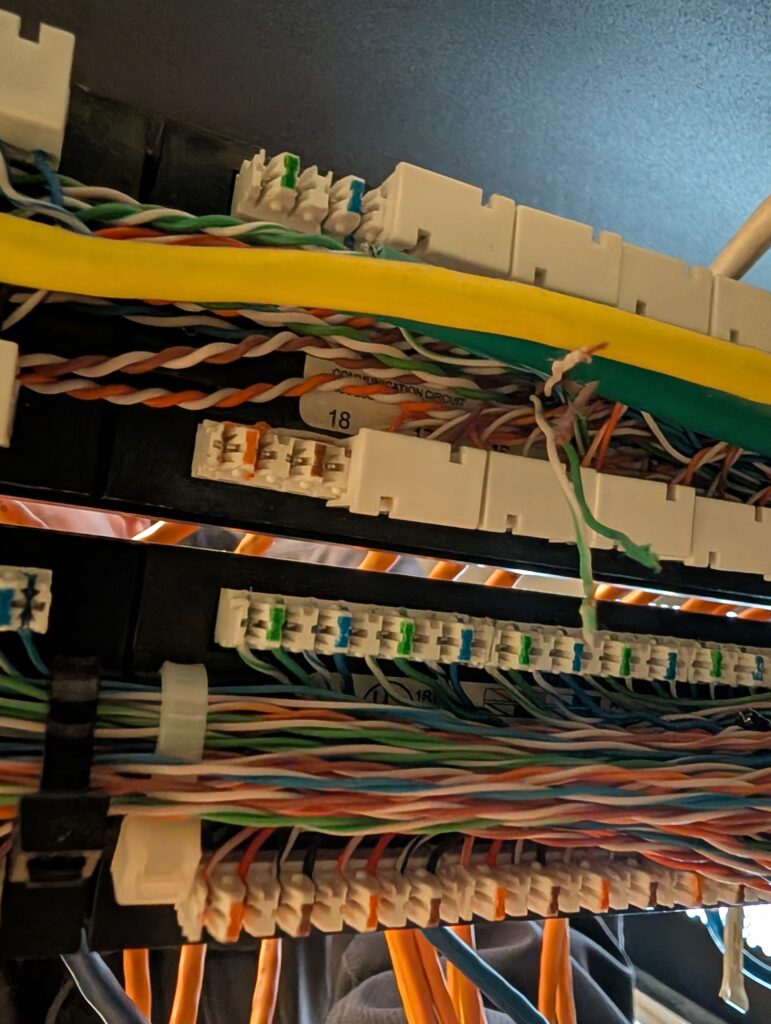
- Cables pulled too tight around corners
- Untwisted pairs at the termination point
- Cheap patch panels or keystones
- Runs bundled tightly with power cables
All of these things introduce interference and signal degradation.
So when someone says, “We upgraded to CAT6A but still have slow speeds,” the cable usually isn’t the problem—the installation is.
Distance Is a Silent Performance Killer
Distance is where CAT6 starts to show its limits.
If you’re trying to push 10 Gigabit over CAT6 across a warehouse, large office, or multi-floor building, you’re going to run into issues fast.
From experience:
- CAT6 is fine for typical office runs
- But once you start stretching distances or increasing bandwidth demands, performance drops off
- CAT6A handles those longer runs much more reliably
This is especially important in environments like:
- Warehouses
- Manufacturing floors
- Large retail spaces
Interference Is a Bigger Problem Than You Think
In real-world installs, we deal with a lot more than just data cables.
You’ve got:
- Electrical lines
- Fluorescent lighting
- Machinery
- Wireless equipment
CAT6 can struggle in high-interference environments. CAT6A, with better insulation and tighter twists, does a much better job resisting that noise.
If your network runs near heavy equipment or power sources, that upgrade to CAT6A isn’t just “nice to have”—it can be the difference between a stable network and constant headaches.
Bandwidth Demands Are Growing—Fast
A few years ago, most businesses were fine with 1 Gigabit networks.
Now?
- Cloud applications are constant
- VoIP systems are everywhere
- Security cameras are streaming 24/7
- File transfers are larger than ever
And more companies are starting to adopt:
- 2.5G and 5G networking
- 10G uplinks between switches
This is where CAT6 starts to feel tight.
It’s not obsolete—but it’s not as “future-proof” as people think.
When CAT6 Is Still the Right Choice
I’m not here to knock CAT6—it still has a place.
CAT6 is a solid option when:
- Runs are short
- Budget is a concern
- Network demands are moderate
- You’re working in a low-interference environment
For many small offices, it gets the job done just fine.
When You Should Be Looking at CAT6A (or Beyond)
From a technician’s perspective, I recommend CAT6A when:
- You’re wiring a new building
- You expect growth in data usage
- Runs are longer
- The environment has interference risks
- You want reliable 10G capability
And in some cases, I’ll say it straight:
If you’re thinking long-term infrastructure, you should at least be considering fiber.
The Biggest Misconception: “Future-Proof” Cabling
Here’s the truth from the field:
There’s no such thing as truly future-proof cabling.
There’s only:
- Well-planned infrastructure
- Proper installation
- Room to scale
I’ve seen brand-new CAT6 installs become limiting in just a few years—not because the cable failed, but because the business outgrew it.
Final Thoughts from the Field
At the end of the day, cabling isn’t just about specs—it’s about how your business actually operates.
The right question isn’t:
“Is CAT6 good enough?”
It’s:
“What will our network need to handle over the next 5–10 years?”
That’s the conversation we have with clients at Advanced Computer Services (ACS) every day.
Because pulling cable is the easy part.
Getting it right the first time—that’s what saves you money.
